What is AQMD Rule 403 in Los Angeles?
AQMD Rule 403 is the South Coast AQMD’s fugitive dust rule. It applies to any activity or man-made condition that can raise fugitive dust. Dust from a site cannot stay visible past the property line. The AQMD says the rule requires best available dust control measures during active operations.
Planning a teardown or a dirt removal job? Rule 403 covers that work. Southwest Hauling is a demolition and hauling contractor in Los Angeles, licensed and insured, CA License 792182.
Where Rule 403 comes from
Rule 403 belongs to the South Coast Air Quality Management District, known as the South Coast AQMD or SCAQMD. It was adopted May 7, 1976, and the latest amendment printed on it is dated June 3, 2005. South Coast AQMD rules apply in every Westside and South Bay city we serve. The AQMD defines fugitive dust as particulate matter suspended in the air by direct or indirect human activities.
What Rule 403 covers
The rule’s active operations include earth-moving, construction and demolition, disturbed ground and vehicle movement. Its definitions name grading, excavation, crushing, loading dirt and adding to or taking from storage piles. Bulk material means sand, gravel, soil, aggregate under two inches and similar particulate matter.
So a house demolition falls under the rule, and so does a dirt haul-off. Breaking out a slab for concrete removal does too.
Who Rule 403 applies to
The limits apply to any person who causes or allows the dust. The rule defines a contractor as anyone with a contract to run an active operation for another person. So the duty can reach the contractor and the property owner alike. A contractor is exempt after its contract ends, if it used the required controls during the contract.
The limits every job has to meet
- Dust from an active operation, an open storage pile or disturbed ground cannot stay visible past the property line.
- Dust from a moving motor vehicle cannot exceed 20 percent opacity, a measure of how much it blocks the view.
- No active operation can run without the Table 1 best available control measures that apply to it.
- PM10 means small airborne particles. When air is sampled upwind and downwind of a site, the PM10 difference cannot top 50 micrograms per cubic meter.
Track-out and the exits onto the street
Track-out is bulk material, such as dirt, that vehicles and equipment carry onto a paved road. It cannot reach 25 feet or more in cumulative length from the site. All of it has to be removed at the end of each workday or evening shift.
A site with 5 or more disturbed acres needs a track-out control at each exit onto a paved public road. So does one importing or exporting 100 cubic yards or more of bulk material a day. The rule’s options:
- A washed gravel pad, 1 inch minimum stone, at least 6 inches deep, 30 feet wide and 50 feet long
- Paving at least 100 feet long and 20 feet wide
- A wheel shaker at least 24 feet long and 10 feet wide
- A wheel washing system
- Another measure the AQMD’s Executive Officer and the U.S. EPA approve as equivalent
Haul trucks, freeboard and Vehicle Code 23114
For importing or exporting bulk material, Table 1 asks for at least six inches of freeboard on haul vehicles. That is space between the load and the top edge of the bed. Table 1 also says to comply with Vehicle Code Section 23114, and its guidance suggests tarps or other suitable enclosures. For truck loading, it says to pre-water the material first.
Vehicle Code 23114 is state law. It bars hauling aggregate material, including dirt, sand, gravel, crushed base and asphalt, on a highway uncovered. An uncovered load must sit six inches below the upper edge at the sides, front and back. Its peak cannot rise above that edge.
Construction dust control by job type
Table 1 applies to all construction activity sources.
Demolition
Table 1 says to stabilize wind erodible surfaces, loose soil and demolition debris. Its guidance says to apply water in sufficient quantities to prevent visible dust plumes. Demolition also has to comply with AQMD Rule 1403, the asbestos rule.
Earth-moving and grading
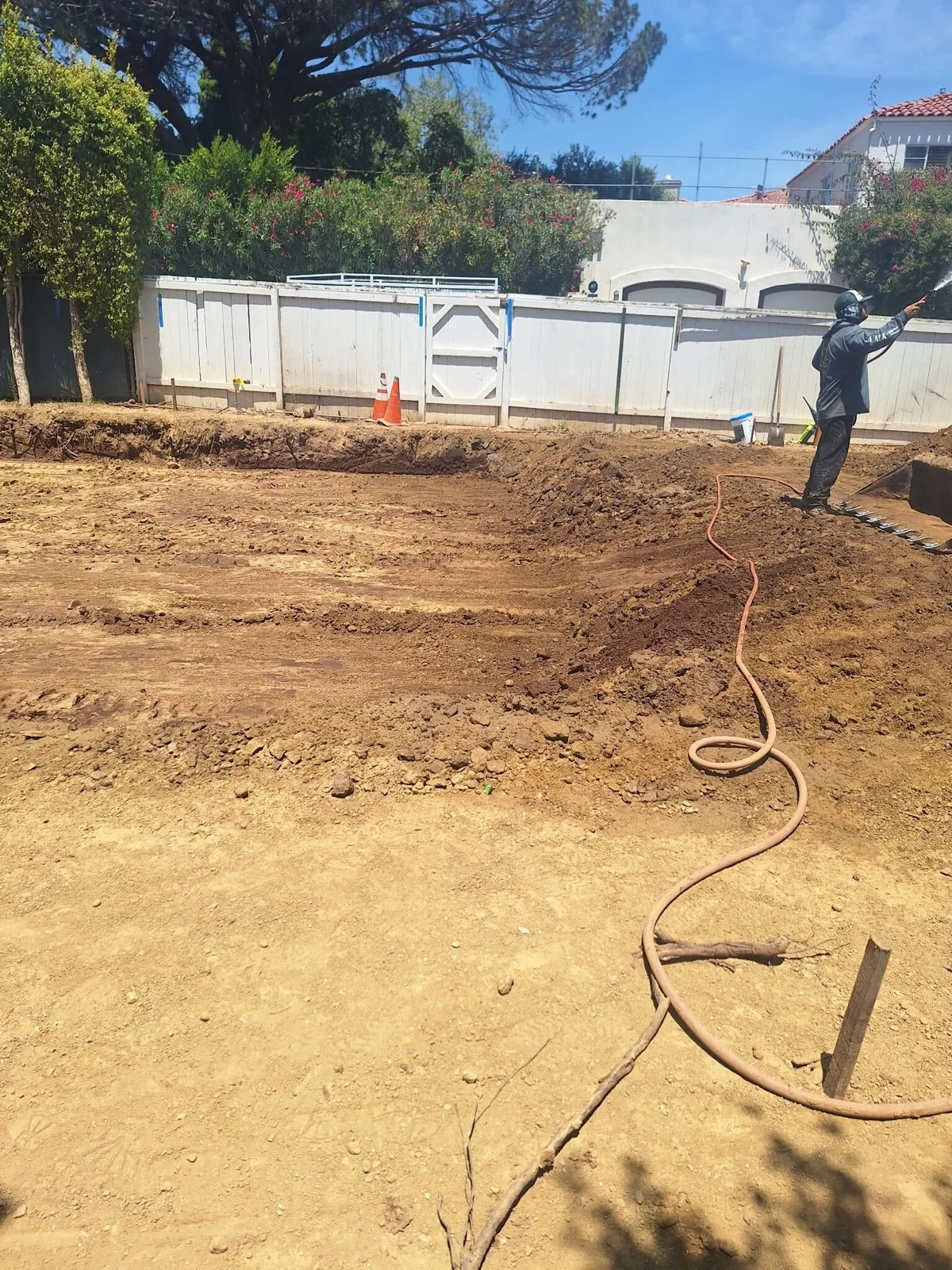
Table 1 says to pre-apply water to the depth of the proposed cuts. Then keep the soil damp so visible dust stays within 100 feet in any direction. The property line limit still applies. Our grading and trenching work falls here.
Trenching
Table 1 says to stabilize surface soils where the trencher or excavator and support equipment will operate.
Backfilling
The guidance says to mix backfill soil with water before moving it. Filling in an old pool is backfilling, the work on our pool fill-in page.
Stockpiles
Within 100 yards of an off-site occupied building, a stockpile can be no more than eight feet tall. The other choices: a road bladed to the top for a water truck, or irrigation that covers the whole pile.
An open storage pile is uncovered bulk material at least three feet high, covering 150 square feet or more. A dirt pile waiting in a yard can qualify.
Vacant land
A vacant lot of 0.10 acre or more, with 500 or more square feet driven on, needs barriers against vehicles.
Large operations and why a home job is not one
Under the rule, a large operation has 50 or more acres of disturbed surface area. The AQMD’s Rule 403 page also counts earth-moving of 5,000 cubic yards (3,850 cubic meters) in a day. That has to happen three times in the most recent 365 days.
The AQMD’s page says large operations file Form 403N within 7 days of qualifying. Once approved, it is valid for one year. A site-specific dust plan can go in instead. The rule adds daily dust control records kept at least three years, and project contact signs before earth-moving starts.
It also requires a dust control supervisor, on site or within 30 minutes during working hours. That person has completed the AQMD Fugitive Dust Control Class. The AQMD says those certifications are valid for 2 years.
A typical home demolition or backyard grading job is far below both lines. For those jobs, the general rules above are what apply.
High wind and large operations
The rule defines high wind conditions as instantaneous wind speeds above 25 miles per hour. For large operations, its Table 3 sets contingency measures. For earth-moving, that means stopping all active operations, or watering the soil no more than 15 minutes before moving it.
The weed abatement exemption
Rule 403 exempts weed abatement ordered by a fire department or a county agricultural commissioner. The mowing or cutting has to leave weed stubble at least 3 inches above the soil. Our weed abatement work is done to the LAFD fire code.
Rule 403 by the numbers
| Rule item | What it says | Where it applies |
|---|---|---|
| Visible dust | Not visible past the property line | Active operations, open storage piles, disturbed ground |
| PM10 | 50 micrograms per cubic meter, upwind and downwind difference | When the air is sampled |
| Track-out | Under 25 feet, removed each workday or evening shift | Every active operation |
| Exit controls | One at each exit to a paved public road | 5 or more disturbed acres, or 100 or more cubic yards a day in or out |
| Freeboard | At least 6 inches | Haul vehicles moving bulk material |
| Earth-moving dust | Within 100 feet in any direction, soil kept damp | Earth-moving |
| Stockpiles | 8 feet tall at most, or a bladed road or full irrigation | Within 100 yards of off-site occupied buildings |
| Large operation | Form 403N within 7 days, records kept 3 years | 50 or more disturbed acres, or 5,000 cubic yards a day three times in 365 days |
How to report dust in Los Angeles
The AQMD’s online complaint system takes reports of dust and other air contaminants. Its complaints page also lists 1-800-CUT-SMOG. For questions about dust control, the AQMD lists a toll-free Dust Hotline at (866) 861-3878.
How our crews handle dust
On our jobs, crews water the work area to keep dust down. Dirt and debris we load leave in our own trucks the same day. Our job site safety page covers how we run a site. For a free in-person estimate, call (310) 546-4855.
This is a plain-language summary of Rule 403: the AQMD’s rule text governs, and this is not legal advice.