What is AQMD Rule 1403 in Los Angeles?
AQMD Rule 1403 is the South Coast AQMD’s asbestos rule for demolition and renovation. It requires an asbestos survey before any demolition or renovation. Every planned demolition also needs an AQMD notice at least 10 working days before it starts.
Were you told your teardown or remodel needs an AQMD notice or an asbestos survey? Rule 1403 is the reason. Southwest Hauling is a demolition contractor, licensed and insured, CA License 792182. We schedule each house demolition after the survey and the AQMD notice, and the debris leaves in our own trucks.
Where Rule 1403 comes from and who enforces it
Rule 1403 belongs to the South Coast Air Quality Management District, known as the South Coast AQMD or SCAQMD. It was adopted October 6, 1989. The latest amendment printed on the rule is dated October 5, 2007.
It builds in the federal asbestos rules known as the asbestos NESHAP. The EPA delegated enforcement to the South Coast AQMD, the local enforcement authority for asbestos. The AQMD issues no demolition or asbestos permits. Rule 1403 requires a notification instead.
What counts as a demolition under Rule 1403?
Rule 1403 treats demolitions and renovations differently. It defines demolition as wrecking or taking out any load-supporting structural member of a building.
That bar sits low. The AQMD’s FAQ says removing as little as one two-by-four from a load-bearing wall counts as a demolition. Foundations, slabs, rafters and porch pillars are load-bearing members too.
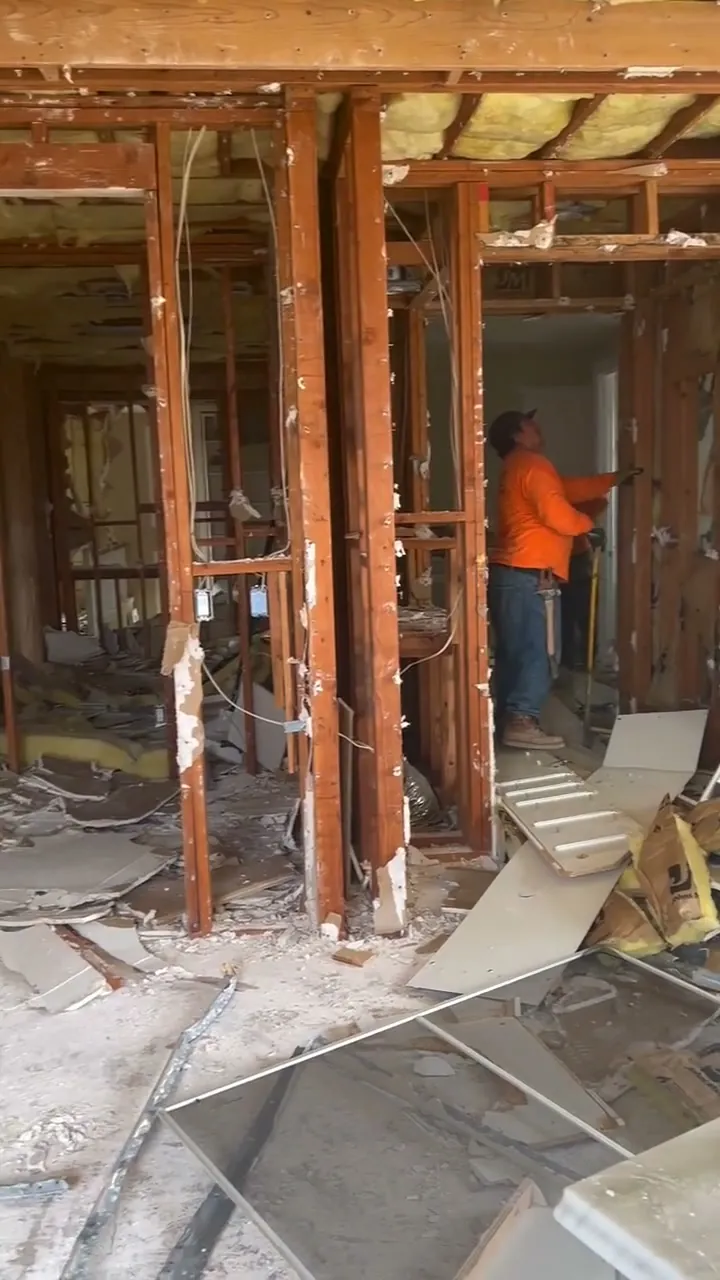
So an interior demolition that takes out part of a load-bearing wall counts as a demolition. Remodels that remove no load-supporting member still fall under the rule as renovation work.
The asbestos survey comes first
The survey comes before any demolition or renovation, and it covers the building or the parts being worked on. The AQMD requires it before demolition regardless of the date of construction. It also says there is no date when asbestos in building materials was banned.
A Certified Asbestos Consultant (CAC) or a Certified Site Surveillance Technician (CSST) does the survey. The rule requires the surveyor to be certified by Cal/OSHA and to have passed an EPA-approved Building Inspector Course.
A thorough survey covers every affected material. That includes all layers of flooring down to the joists, and material inside wall or ceiling cavities. The written survey describes the building’s general condition, including any obvious fire or structural damage. It lists the suspect materials and the samples collected, with a sketch of where samples were taken.
An architect’s or engineer’s inspection calling a building asbestos-free does not satisfy Rule 1403. A lab report alone is not a survey either. Surveys do not expire, but each one must reflect the current condition of the materials. Changed materials need at least an update.
How the AQMD notification works
Rule 1403 requires notice of the intent to do any demolition or renovation. A demolition needs the notice whether or not the survey found asbestos.
For planned work, the notice is due no later than 10 working days before the work starts. The AQMD FAQ states it as 10 working days, or 14 calendar days. That clock covers any demolition and any removal of more than 100 square feet of intact asbestos-containing material.
The contractor doing the demolition or renovation submits the notice through the AQMD’s Rule 1403 Notification Web Application. If the owner hires a new contractor during the 14-day period, a new 14-day period starts.
The notice lists the building’s square footage and floors, its age and its present or prior uses. It also names the disposal site for any asbestos waste. No notice counts as received unless the Rule 301 fee comes with it. A change of 20 percent or more in the notified asbestos amount must be reported to the AQMD.
What does the AQMD notification cost?
Demolition notification fees are based on the size of the structure, or the part of it, being demolished. These are the AQMD’s own fees by project footprint, from its fee sheet revised June 30, 2025:
| Project footprint | AQMD notification fee |
|---|---|
| Up to 1,000 square feet | $81.61 |
| Over 1,000 to 5,000 square feet | $249.59 |
| Over 5,000 to 10,000 square feet | $584.26 |
| Over 10,000 to 50,000 square feet | $916.15 |
| Over 50,000 to 100,000 square feet | $1,327.75 |
| Over 100,000 square feet | $2,212.92 |
For what the work itself costs, see our house demolition cost guide or our interior demolition cost guide. Check the AQMD’s current fee sheet before you budget.
Late notice costs more. An initial notice sent less than 14 calendar days before the start date adds an $81.61 special handling fee. Paying it does not waive the 14 calendar day notice requirement.
A demolition with asbestos left in place needs a Procedure 5 plan. That plan carries a $916.15 plan evaluation fee on top of the notification fee.
What happens when the survey finds asbestos?
Under the rule, asbestos-containing material means material with more than 1 percent asbestos. It has to come out before any demolition or renovation work that would break it up or disturb it. On our jobs, a separate certified abatement contractor does that removal, never our crews.
The rule has a narrow exception. Nonfriable packings, gaskets, resilient floor covering and asphalt roofing in good condition may come out after demolition starts. That takes prior AQMD approval under a Procedure 5 plan.
Renovations and the exemptions
Rule 1403 covers renovation work too, such as a kitchen and bathroom demolition. The work area gets surveyed first unless an exemption applies.
Renovating a single-unit home? No survey is required if less than 100 square feet of asbestos-containing material is removed or stripped. No notice is required for renovation work that removes or strips less than 100 square feet of that material. A demolition gets neither exemption.
The rule also does not apply to an owner-occupant of a single-unit home who personally does a renovation there. Per the AQMD FAQ, no contractor, laborer, friends or family can help, so hiring a crew ends the exemption. The exemption does not cover condominiums, townhouses or apartments.
How the AQMD notice ties to the city demolition permit
The AQMD notice comes before the city demolition permit. The AQMD FAQ cites California Health and Safety Code 19827.5 here. Under it, a city cannot issue a demolition permit until the applicant provides a copy of the AQMD notification.
Some cities also require proof of the notice before they issue a renovation or demolition permit. Our demolition permit guide covers the city side of a Los Angeles teardown.
Emergency demolitions
An emergency demolition, in the rule’s terms, is one a government agency orders to eliminate a danger. The danger can be collapse, fire, crime, disease or toxic contamination, for example. For one of these, the AQMD is notified as soon as possible, but before the demolition.
The order of steps for a Los Angeles teardown
For a planned teardown, the AQMD’s notification instructions set the order:
- The asbestos survey, by a CAC or CSST.
- Abatement, if the survey found asbestos.
- The AQMD notice, at least 10 working days ahead, with the fee.
- The city demolition permit, with a copy of the notice.
- The teardown and the haul-off.
Removing more than 100 square feet of intact asbestos needs an AQMD notice too, on the same clock.
An estimator walks you through this order at the free estimate. Our part is the teardown after the survey and the AQMD notice, and our own trucks haul the debris away.
Our job site safety page covers how our crews run the site. To book a free estimate, call (310) 546-4855 or contact us online.