How much does concrete removal cost in Los Angeles?
HomeGuide puts concrete removal at $3 to $8 per square foot, disposal included. Los Angeles sits toward the top of any national band. HomeAdvisor prices urban work at $6 to $14 per square foot. Thickness, reinforcing, access and dump fees move the number. An on site look sets the real one.
This guide is for driveways, patios, pool decks and slabs on the Westside and in the South Bay. It covers the per square foot math, a table by project type, and where the concrete ends up. For how the work runs, read our concrete removal page.
How is concrete removal priced?
By the square foot, most of the time. HomeGuide puts the range at $3 to $8 per square foot with disposal. Forbes Home puts slab removal at $2 to $6 per square foot. LawnStarter’s 2026 figure is $2 to $7 per square foot. Thickness, reinforcing and access decide where a job lands inside those bands.
Whole project numbers tell the same story. HomeAdvisor puts a typical concrete removal project between $542 and $1,746. Its average is $1,139. Thumbtack reports $640 to $2,087, and most people pay around $1,132. Fixr runs wider, $500 to $5,000. Its national average of $1,856 works out to roughly 600 square feet of sidewalk.
Small jobs carry a floor. Forbes Home notes that some contractors may charge a project minimum, usually around $1,000. HomeGuide puts labor at $50 to $100 per person per hour. Hours on site are most of what you pay for.
What do common concrete removal projects cost?
Published guides price residential concrete by project once they know the size, and their bands do not always agree. Treat the table below as a planning range. Measure your square footage and check it against the per square foot numbers above.
| Project | Published range | Source |
|---|---|---|
| A 10 by 10 concrete slab | $300 to $800 | HomeGuide |
| A concrete driveway of 200 to 600 square feet | $1,200 to $4,500 | HomeGuide |
| A concrete driveway | $1,000 to $2,500 | HomeAdvisor |
| A 20 by 20 concrete patio | $1,200 to $3,000 | HomeGuide |
| A pool deck | $1,000 to $2,000 | HomeAdvisor |
| A 50 foot concrete sidewalk | $750 to $1,250 | HomeGuide |
| Sidewalk removal | $900 to $2,500 | HomeAdvisor |
| Concrete stairs or steps | $250 to $500 | HomeGuide |
| A 2 car garage floor | $1,000 to $3,500 | HomeGuide |
| A concrete footing | $350 to $500 | Fixr |
| An old foundation | $4,000 to $10,000 | Fixr |
The two driveway rows show the spread. HomeGuide prices a 200 to 600 square foot driveway at $1,200 to $4,500. HomeAdvisor prices a driveway at $1,000 to $2,500. Neither one has seen your slab thickness or your gate width.
Foundations sit in a category of their own. Fixr puts removing an old foundation at $4,000 to $10,000. That usually comes up after a structure is already down. Pricing for the whole teardown lives in our house demolition cost guide.
What drives the price of concrete removal in Los Angeles?
Five things, in rough order: thickness, reinforcing, access, disposal and local labor rates. A three inch unreinforced patio a machine can drive up to is the cheap end. A six inch driveway laced with rebar behind a locked gate on a hillside street is the expensive end. Most jobs land between them.
Thickness is material. A six inch slab holds twice as much concrete per square foot as a three inch slab, per HomeAdvisor. Twice the weight is twice the breaking, twice the loading and twice the tonnage at the scale.
Reinforcing is next. HomeGuide puts removing reinforced concrete at $1 to $3 per square foot more. HomeAdvisor says reinforced concrete can cost 50 to 100 percent more to remove, averaging $6 per square foot. Wire mesh holds broken slabs together in mats that have to be cut apart before anything loads.
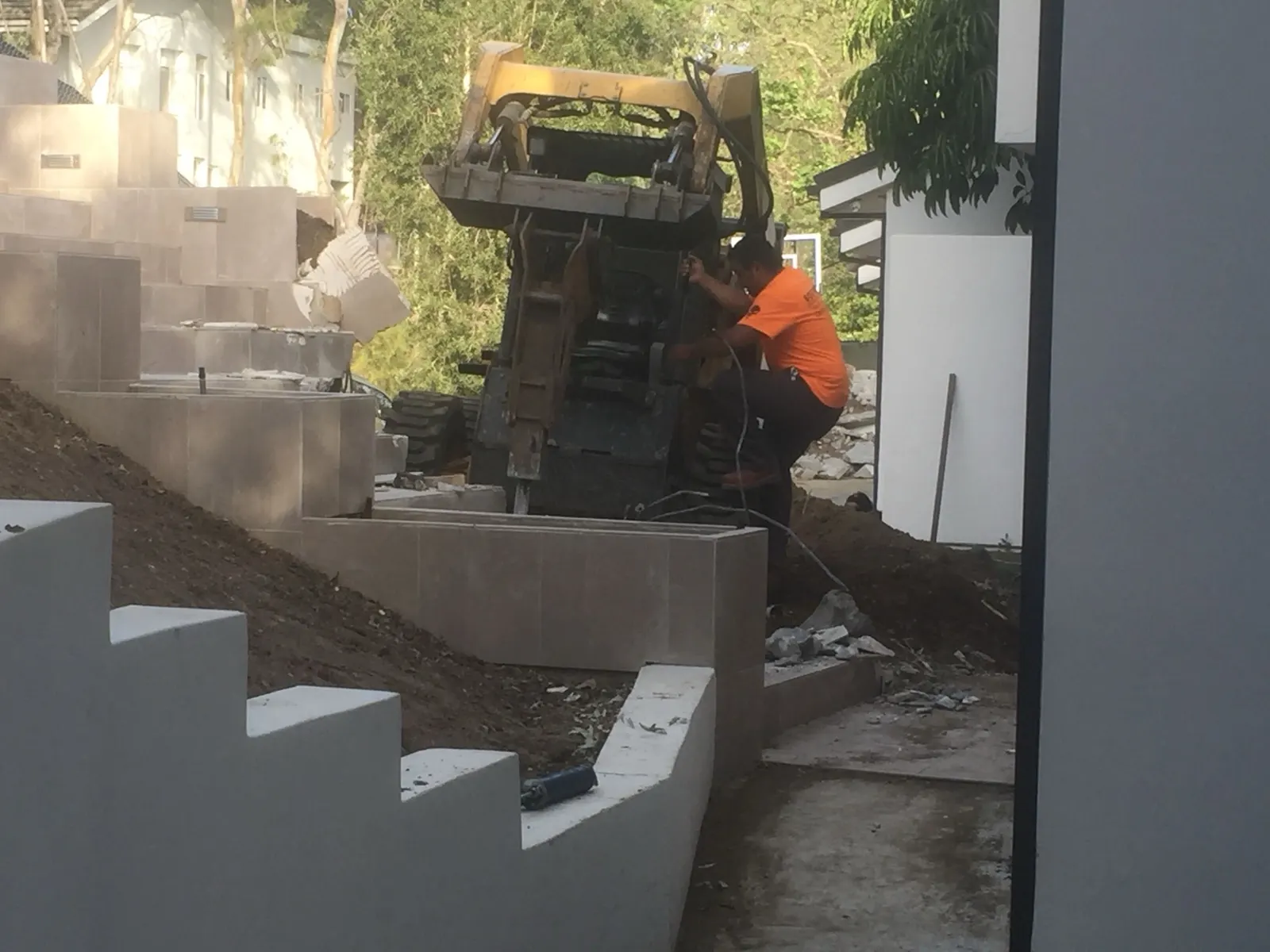
Access is the Los Angeles line. Westside and South Bay lots run to narrow side yards, locked gates and driveways that drop away on a slope. A compact skid steer fits through most standard gates and keeps the day short. Where a machine cannot reach, jackhammers and hand carry take over, and that is hours.
Disposal is weight, not volume. HomeGuide puts dump fees at $90 to $160 per ton. Thumbtack says dumps typically charge up to $100 per ton, which is 2,000 pounds. LawnStarter puts disposal fees between $51 and $100 per ton. Fixr puts the disposal share at about $0.50 to $2 of the per square foot price.
Labor here is coastal labor. Forbes Home notes that urban and coastal areas with a higher cost of living usually command higher labor rates. HomeAdvisor’s urban figure of $6 to $14 per square foot sits above HomeGuide’s national $3 to $8. Plan for the upper half of any national range.
Do you need a permit to remove concrete in Los Angeles?
It depends on where the concrete sits. HomeGuide’s rule is that a permit is needed when the concrete is in the public right of way. In the City of Los Angeles that is a Bureau of Engineering A-Permit. Municipal Code Section 62.105 requires a permit be obtained for construction in the public right-of-way.
The right of way is the strip the City controls, not the part of the lot you own. Sidewalks, driveway approaches and curbs sit inside it. Pull a public sidewalk panel, or take out a driveway approach at the street, and that A-Permit comes first.
Published permit costs are modest where one applies. HomeGuide puts a concrete removal permit at $50 to $400. LawnStarter puts it between $38 and $300. City fees are set by the City, so treat those figures as a ballpark.
This guide does not cover permits for any other kind of concrete work. What applies depends on the job and the city the property sits in. The estimator checks that before a crew shows up.
Where does the concrete go in Los Angeles?
Into the recycling stream, mostly. Clean concrete goes to certified recycling facilities where it is crushed into base rock. Rebar and other metal go to metal recycling. What is left goes to a licensed transfer station. It leaves in our own trucks the same day, so the driveway stays clear.
The City of Los Angeles sets the route. Municipal Code Section 66.32.1 covers anyone who collects, removes or transports solid waste generated inside the City. Construction and demolition waste counts. Those haulers have to obtain an AB 939 Compliance Permit from the Bureau of Sanitation. The permit then requires delivery to a Certified Construction and Demolition Waste Processing Facility.
Ordinance 181519 says it in plainer words. Construction and demolition waste generated within the City of Los Angeles must be taken to a City certified construction and demolition waste processing facility. Penalties start at $1,000 for the first violation and rise to $5,000 for repeat violations inside six months.
Clean concrete is worth something on the way out. LawnStarter notes that many local recycling companies accept concrete debris free of charge or for a nominal fee. Clean broken slab costs less to dump than a mixed load with dirt, wood and wire in it.
How long does concrete removal take?
Most driveway and patio jobs run one to two days. A small walkway can be a morning. Pool decks and slabs behind locked gates take longer, because every piece travels further to reach the truck. Days drive the price, since the labor behind them is priced by the hour.
The sequence is the same on most jobs. The crew makes a saw cut where the old concrete meets what stays. A hydraulic breaker breaks the slab into pieces a machine can pick up. A skid steer loads the truck, which runs to the recycling yard and comes back.
When does a concrete removal job cost less, or more?
Less when the slab is thin, unreinforced and easy to reach. Fixr puts thin sections lifted by a skid as low as $2 a square foot. More when it is thick, reinforced and hemmed in. Fixr prices cutting through both the concrete and the rebar at $4 to $6 a square foot. That gap is most of the quote.
Pool decks split two ways. Deck only, with the shell staying in the ground, prices at the pool deck range in the table above. Deck and shell together is pool demolition, which prices in a band of its own.
Footings and old foundations usually surface after a structure is gone. On a teardown the slab, the footings and the foundation get priced inside the house demolition. One set of trucks hauls all of it.
What does the ground look like after the concrete is gone?
Bare dirt, raked flat. The crew pulls the broken pieces, picks the rebar out and levels the area off. Under an old driveway there is usually compacted base rock. Under a patio it is usually plain soil. What goes on top is a separate job.
If new concrete, planting or a lawn is going in, the dirt usually needs shaping first. That is rough grading, and it can run the same day the last load leaves. A slope, a low spot that holds water, or a pad for new flatwork gets handled there.
Concrete prices by weight and by access, and neither shows up on a phone call. An estimator comes out, measures the area and checks the thickness and reinforcing. The visit also covers how a machine and a truck get in. Breaking and haul off come back as one number. That visit is free. Call (310) 546-4855 or send us the details and we will set a time.